
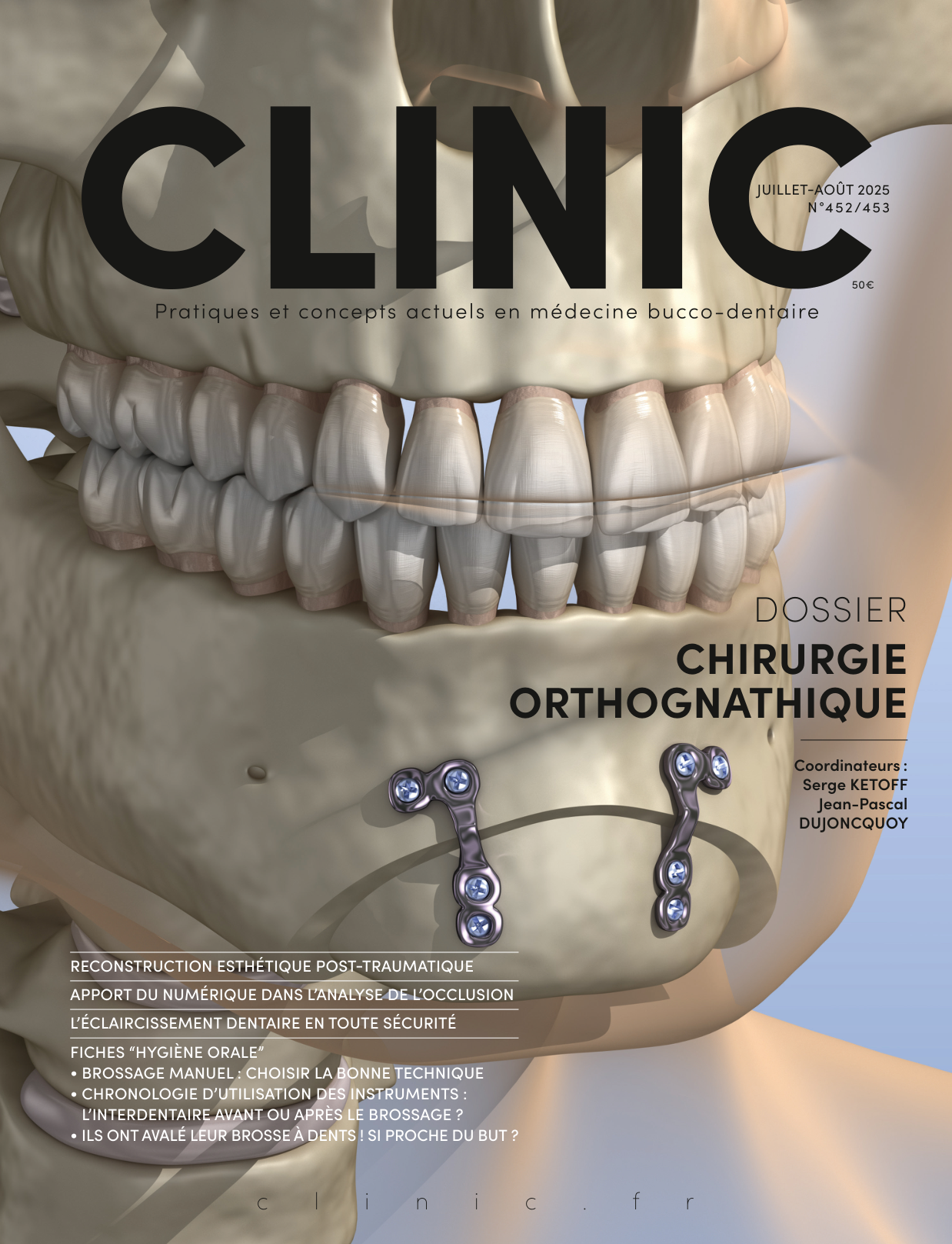
Orthognathic Surgery Special Issue — CLINIC 2025
Special issue coordinated by Dr Serge Ketoff and Dr Jean-Pascal Dujoncquoy
CLINIC No. 452/453 · July–August 2025
Editorial — Orthodontic and Surgical Protocols: A Multidisciplinary Surgical Odyssey
It is with great pleasure that we present a series of articles dedicated to orthognathic surgery, highlighting the many facets of this complex and essential discipline.
Orthognathic surgery is by nature a multidisciplinary endeavour, weaving close ties between orthodontics, maxillofacial surgery, periodontics, implantology, general dental practice, physiotherapy and ENT. The goal of treatment is to restore occlusion by normalizing function (mastication, swallowing and breathing), while taking into account upper airway volume and the social and aesthetic impact of jaw growth anomalies. This care applies to both children and adults.
The five articles in this series will guide you through crucial topics: from functional and aesthetic genioplasty to the importance of the transverse dimension for occlusal stability. You will also explore the subtleties of bimaxillary surgery and its planning, with a feature focused on the vertical dimension.
Innovation lies at the heart of our professions, particularly 3D surgical planning, which has revolutionized the way orthognathic surgery is performed. A dedicated article will show how this approach, combined with "all-on" solutions, has transformed the management of edentulous patients, relegating more invasive procedures such as maxillary advancement with grafting to the past.
We hope this series will spark your curiosity and inspire you to deepen your knowledge of these multidisciplinary protocols for the benefit of your patients.
Happy reading to all, and long live teamwork!
Serge Kétoff & Jean-Pascal Dujoncquoy — Clinic 2025;46(452-453):19.
In This Special Issue
- Maxillary Endognathia: Decision Criteria and Treatment Strategies
Yoann-Luc Vu Van Tuan · Jean-Pascal Dujoncquoy · Serge KetoffMaxillary endognathia, characterized by deficient transverse development of the maxilla, poses specific challenges in orthodontics. This structural disorder often leads to respiratory and occlusal complications, requiring a rigorous therapeutic approach. This article explores the criteria for choosing between orthopedic palatal expansion and surgically assisted distraction for maxillary widening, taking into account technological innovations such as CBCT and bone-borne devices. Achieving an adequate transverse dimension ensures treatment stability by guaranteeing good occlusion and restoring an ideal functional pattern for tongue position, essential for proper swallowing and breathing.
- Genioplasty in Children and Adults: At What Age? Which Indications? Which Techniques?
Jean-Pascal Dujoncquoy · Olivier Esnault · Serge KetoffGenioplasty is a surgical procedure that consists of performing an osteotomy of the bony chin under general anesthesia. The most notable effect of this chin transposition is the morphological change in the patient's profile. Through the variety of its techniques, osteotomy designs, surgical approaches and adjunctive bone grafting, this procedure can address several indications. It can be performed early in growing adolescents for functional purposes, or as a complement to orthognathic surgery to correct retrogenia, excessive facial height or asymmetry. While this technique is useful in the aesthetic management of the patient, it is also the functional treatment of choice for managing lip incompetence.
- Guided Orthognathic Surgery: In-House 3D Printing and Patient-Specific Implants
Serge Ketoff · Gabrielle Magnant · Natacha NiezOrthognathic surgery has benefited from digital tools, as was the case for implantology. Creating a digital clone of the patient allows the practitioner to plan the surgery on a computer. Skeletal acquisition is performed via CT scan or cone-beam, dental acquisition via optical impression, and skin surface acquisition via photogrammetry or scanning. Transferring this plan to the operating room can be done in multiple ways: more than ten years of follow-up have validated two solutions — occlusal splints, which can be 3D printed in the office, or cutting/predrilling guides and patient-specific titanium plates produced by an industrial manufacturer.
- Optimizing the Aesthetic Outcome: The Vertical Position of the Maxillary Incisor
Serge Ketoff · Jean-Pascal Dujoncquoy · Mehdi Sersab · Alexia GelasThe maxillary central incisor is a key element defining the lower third of the face. It provides support to the upper lip through its anteroposterior projection and its inclination in the sagittal plane. In the frontal plane, the position of the incisal edge of the maxillary incisor defines tooth display at rest and when smiling, as well as the amount of gingiva visible at maximum smile. Beyond the smile, the position of the maxillary central incisor determines mandibular position through occlusion. It thus contributes to the static and dynamic morphology of the lower third of the face, its cis- or trans-frontal projection and its expressiveness.