
Maxillary Reconstruction to Enable Implant Insertion: A Retrospective Study of 181 Patients
Ferri J · Dujoncquoy JP · Carneiro JM · Raoul G
Head & Face Medicine · vol. 4 · 2008
Scientific publication — summary for colleagues and informed patients. Open access article (CC BY).
What is this publication about?
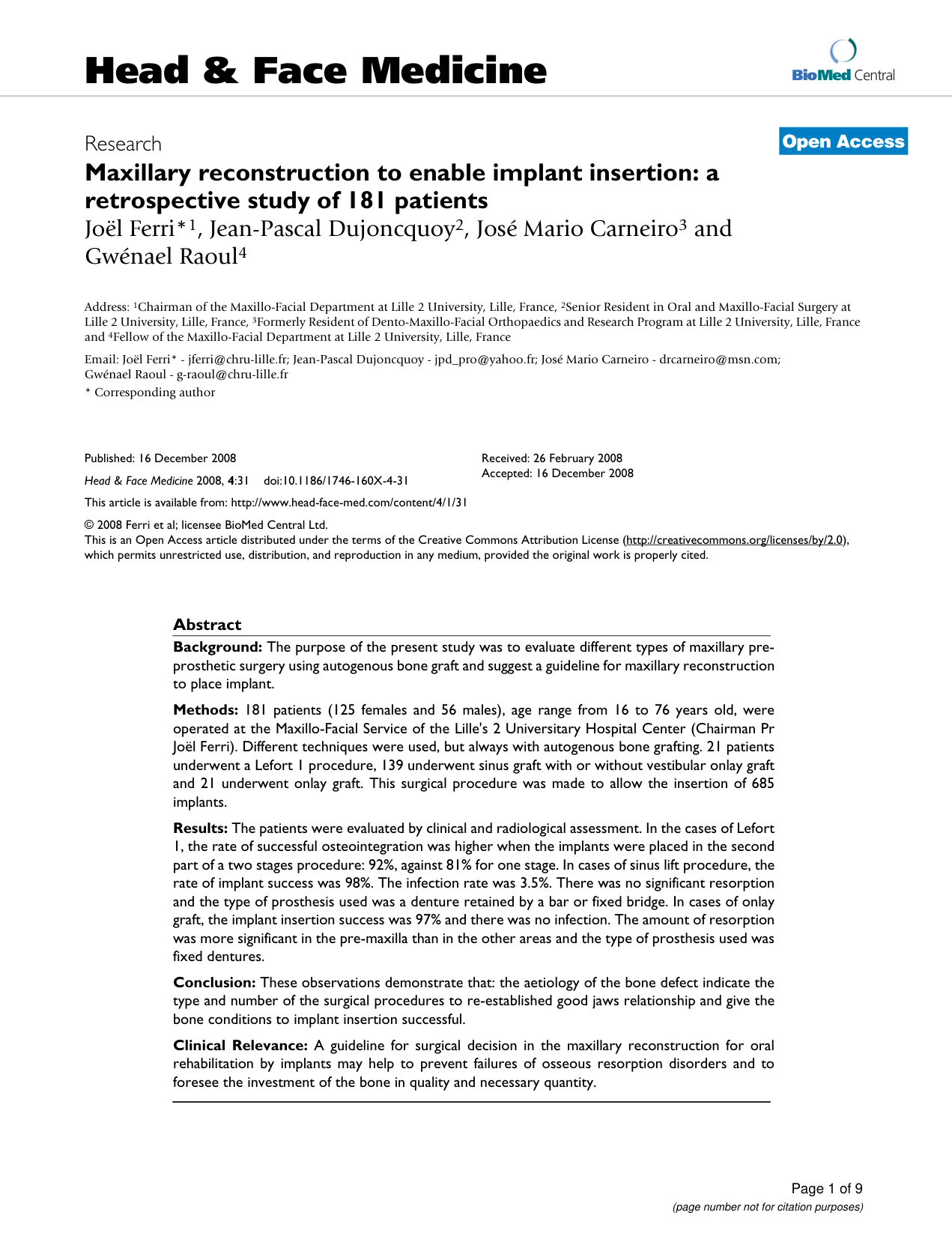
This retrospective study from the maxillofacial surgery department at Lille University Hospital (Prof Joël Ferri) evaluates autogenous bone graft techniques for maxillary pre-prosthetic surgery to enable dental implant placement. In 181 patients, the authors analyse indications according to the aetiology of bone loss.
For colleagues: techniques and outcomes
Three main strategies were used: Le Fort I (21 patients), sinus lift with or without vestibular onlay graft (139 patients), and onlay graft (21 patients), allowing insertion of 685 implants.
Implant success rates reached 98% after sinus lift and 97% after onlay grafting. The authors propose a decision guideline linking bone defect aetiology to the surgical strategy required for successful osseointegration.
In plain language
When the upper jaw lacks bone volume for implants, surgical reconstruction may be performed first. This study shows that several techniques — sinus lift, bone grafting — achieve excellent success rates depending on the cause of bone loss.
Keywords
Maxillary reconstruction · bone graft · dental implants · sinus lift · Le Fort I · pre-implant surgery
Reference : Ferri J, Dujoncquoy JP, Carneiro JM, Raoul G. Maxillary reconstruction to enable implant insertion: a retrospective study of 181 patients. Head Face Med. 2008;4:31. doi:10.1186/1746-160X-4-31.