
Sterilising a Hospital-Made Implant Surgical Guide: Validation of a Test
Z. Ribier · E. Dacosta-Noble · L. Benichou · S. Ketoff · … · E. Moreau
Ann Pharm Fr · 2021 · 79(5):582-588
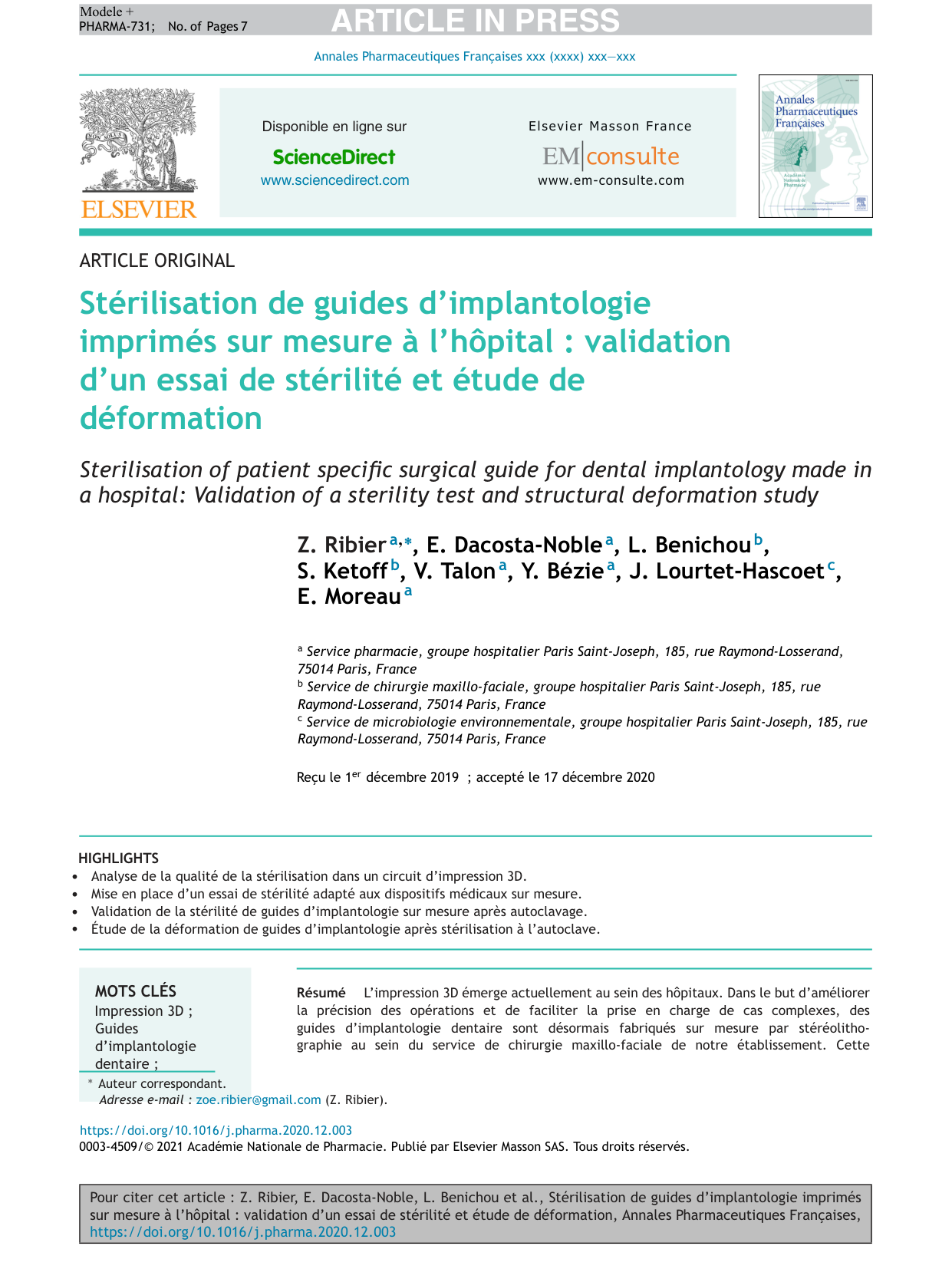
Manufacturing a surgical guide by 3D printing is not enough: its sterility and integrity must be guaranteed. Dr Serge Ketoff co-authored this validation work, essential to the safety of patients and staff.
In brief
- Hospital 3D-printed implant guides must be safely sterilised.
- A sterility test protocol was designed and validated (up to 28 days).
- No guide deformation was observed by the surgeons.
Why validate sterilisation?
Custom 3D-printed medical devices are emerging in hospitals. To improve surgical precision and facilitate complex cases, implant guides are produced by stereolithography. This activity requires securing every step of the manufacturing circuit to protect patients and staff.
Method and results
A sterility test protocol was designed and validated. Guide sterility was checked at 0, 7, 14 and 28 days after autoclave sterilisation. The impact of sterilisation on device structure was assessed visually and during surgery: no deformation was found.
Relevance
The protocol can be extended to other hospitals wishing to validate a sterility test. Further studies could clarify the exact effect of sterilisation on guide structure.
Key points
- Safety of hospital-made 3D guides.
- Sterility test validated up to 28 days.
- No structural deformation after autoclaving.
- Protocol transferable to other centers.
Reference : Ribier Z, Dacosta-Noble E, Benichou L, Ketoff S, Talon V, Bézie Y, Lourtet-Hascoet J, Moreau E. Stérilisation de guide chirurgical sur mesure pour l'implantologie dentaire fabriqué à l'hôpital. Ann Pharm Fr. 2021;79(5):582-588.
PubMed · DOI · Google Scholar · ORCID