
In-House 3D Printing: National Good-Practice Guidelines
R.H. Khonsari · … · S. Ketoff · … · C. Meyer (SFSCMFCO)
J Stomatol Oral Maxillofac Surg · 2021 · 122(4):458-461
3D printing is now part of the daily practice of maxillofacial surgeons. Dr Serge Ketoff contributed to these national guidelines from the French Society of Maxillofacial Surgery (SFSCMFCO) on manufacturing medical devices in hospitals.
In brief
- A national expert group sets good practice for in-house 3D printing.
- Yesterday's technical challenges (printers, software) are now nearly solved.
- The real current issues are economic and regulatory.
A national reference
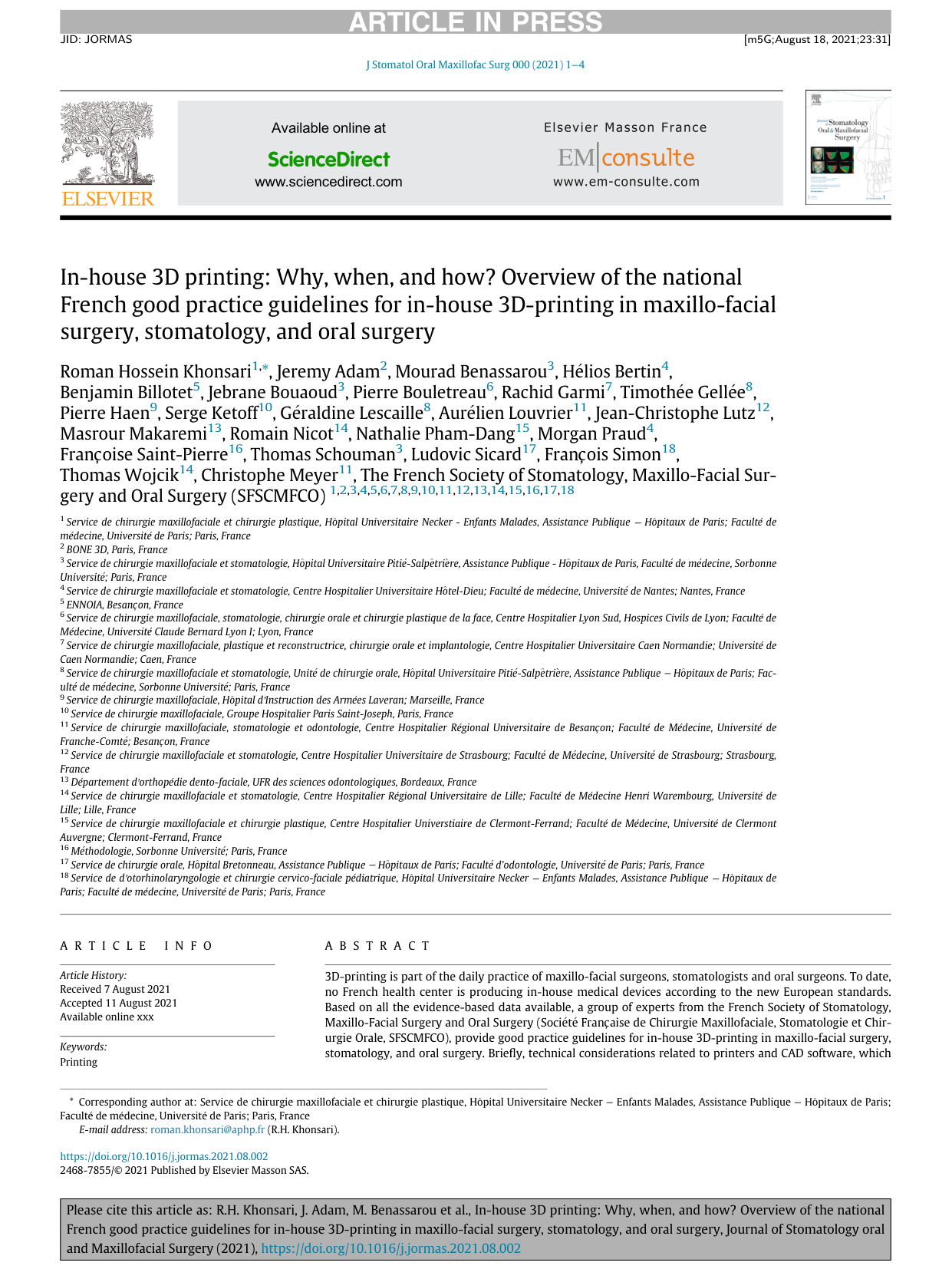
No French center was producing in-house medical devices according to the new European standards. Based on available evidence, an SFSCMFCO expert group — including Dr Ketoff — issued good-practice guidelines for in-house 3D printing in maxillofacial surgery, stomatology and oral surgery.
Where do the real issues lie?
Technical questions (printers, CAD software), which dominated the last decade, have become nearly trivial. The central issues now shift toward economics and regulation: a successful in-house 3D platform relies on close collaboration between clinicians and engineers, backed by regulatory and logistics specialists.
Outlook
Several large-scale academic projects across France should soon provide definitive answers to the governance and economic questions of in-house 3D printing.
Key points
- National SFSCMFCO guidelines — strong authority signal.
- Technical hurdles largely overcome.
- 2020+ issues: economics, regulation, governance.
- Success = clinician / engineer / regulatory collaboration.
Reference : Khonsari RH, Adam J, Benassarou M, et al.; SFSCMFCO. In-house 3D printing: why, when, and how? Overview of the national French good practice guidelines for in-house 3D-printing in maxillo-facial surgery, stomatology, and oral surgery. J Stomatol Oral Maxillofac Surg. 2021;122(4):458-461.
PubMed · DOI · Google Scholar · ORCID